


Blocked Stock & Quarantine: Preventing Mixing Reliably
11. May 2026
Ensuring Delivery Capability Despite a Quality Incident
29. June 2026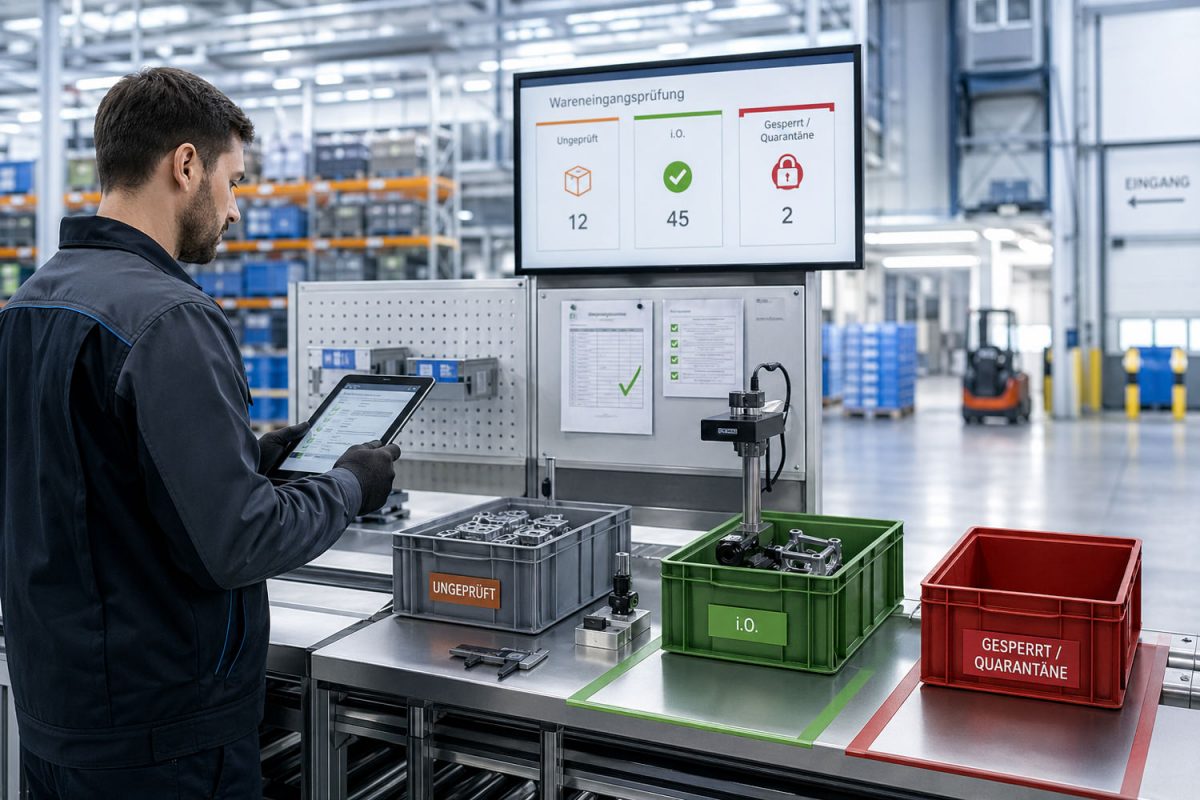
The images on this website were created using artificial intelligence (AI).
Incoming goods inspection is often a contradiction in terms: it is supposed to provide security, but must not slow down logistics. In many companies, it is either too thin (errors slip through) or too heavy (too much effort, too many stops, too much discussion). Both cost money. And both can be avoided if you set up the incoming goods inspection as a controllable process: with clear criteria, appropriate inspection depth, and proper documentation.
This article shows you how to reduce effort while increasing security.
Why Incoming Goods Inspection Often "Doesn't Work"
Usually, it is not due to a lack of will, but due to the system:
-
Inspectors decide based on gut feeling because inspection criteria are not clear.
-
Inspections are carried out "somehow" across the board instead of being risk-based.
-
Supplier and part history is not utilized, even though it represents half the truth.
-
Results are not recorded properly, meaning you learn nothing from repeated errors.
-
Incoming goods inspection is not integrated with production and complaints, creating gaps.
The result: Either too much is inspected (and something still slips through), or too little (and production catches the error at a high cost).
Target Vision: Incoming Goods Inspection as a Filter, Not a Show
A good incoming goods inspection provides you with three things:
-
Early warning: You see trends before things go wrong.
-
Containment: You prevent NOK goods from reaching the line.
-
Proof: You can clearly document what was inspected, both internally and externally.
If your incoming goods inspection achieves exactly that, it is not an "effort," but insurance.
Step 1: Define Inspection Scope Based on Risk (Instead of Flat Rate)
The biggest lever is the question: What is truly critical?
Risk drivers include, for example:
-
Safety- or function-relevant characteristics
-
Tight tolerances/fits
-
New parts, new suppliers, process changes
-
Conspicuous complaint history
-
Long supply chains and multiple transshipments (transport damage)
From this, you build inspection classes. Not complicated, but binding: High-risk parts get more inspection depth, non-critical parts less. This saves effort without leaving you blind.
Step 2: Define Inspection Criteria So That Everyone Inspects the Same Way
Most incoming goods inspections fail due to vague criteria. "Looks good" is not a criterion.
What works:
-
Clear OK/NOK definitions
-
Boundary samples (OK, borderline, NOK)
-
Defined inspection environment for visual inspection (light, distance, time)
-
Defined measurement method for dimensions (measuring equipment, measuring point, handling)
If two inspectors evaluate the same part and come to different results, the inspector is not the problem, but the system.
Step 3: Choose Samples Sensibly (And Not "By Gut Feeling")
Sampling saves time, but only if used correctly. It is not just the sample size that is decisive, but also:
-
How is the sample drawn? (from different boxes, from different layers, from different containers)
-
When is it tightened? (based on hit rate, trend, specific types of errors)
-
When is it reduced? (with a stable history, demonstrable process stability)
A good logic is: In case of an anomaly, ramp up immediately (up to 100%), and ramp down again after stabilization. This keeps you fast and yet secure.
Step 4: Build the Inspection Workflow So That It Does Not Block Logistics
Incoming goods inspection must fit into the material flow. Otherwise, it will be bypassed.
Proven methods include:
-
Clear inspection area near the goods receiving area (no searching, no "where do I inspect this now?")
-
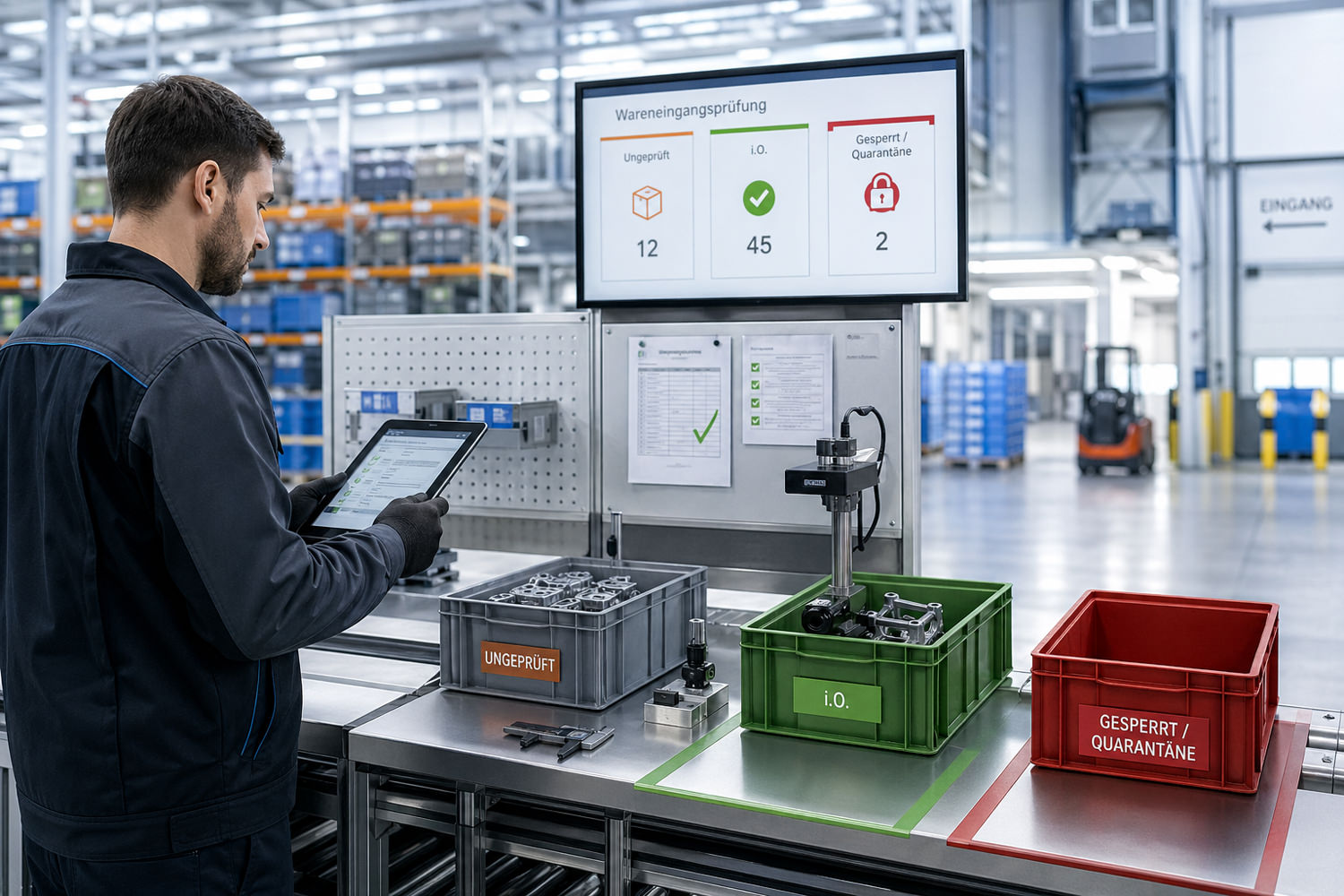
Defined paths: uninspected -> inspected OK -> blocked/quarantine
-
Clear labeling (status visible and traceable)
-
Short reaction paths in case of blocking (who decides, how does it proceed?)
The goal is: An inspection that starts quickly, reaches a result quickly, and separates cleanly immediately in case of NOK.
Step 5: Use Data Instead of Piling Up Inspection Reports
The real gain comes when you learn from incoming goods inspection:
-
Which types of errors recur?
-
With which supplier/batch does it accumulate?
-
Which characteristics are drifting?
-
What does it cost you (time, blockages, rework, downtime)?
If you record inspection results in a structured way, you can adapt inspection plans intelligently. Then the effort decreases automatically because you inspect more purposefully.
Typical Errors That Drive Effort and Lower Security
These are classics that occur almost everywhere:
-
Inspection without clear criteria, leading to discussions and re-inspections
-
Sampling from "the top box," resulting in no representative value
-
No clean quarantine, leading to mixing
-
Blocking is only done "visually," not process-reliably
-
No escalation logic: A hit occurs, but no one knows what applies now
-
No feedback to the supplier and internal root cause analysis
If you eliminate these points, you will quickly notice: Incoming goods inspection becomes calmer, faster, and more effective.
Conclusion: Inspecting Less Does Not Mean Being Less Secure
You don't have to inspect everything to be secure. You have to inspect the right things, with clear criteria, appropriate to the risk, and documented so that decisions can be made quickly.