



Defect Catalog & Boundary Samples: A Standard for All Inspectors
27. April 2026
Optimizing Incoming Goods Inspection: Less Effort, More Security
26. May 2026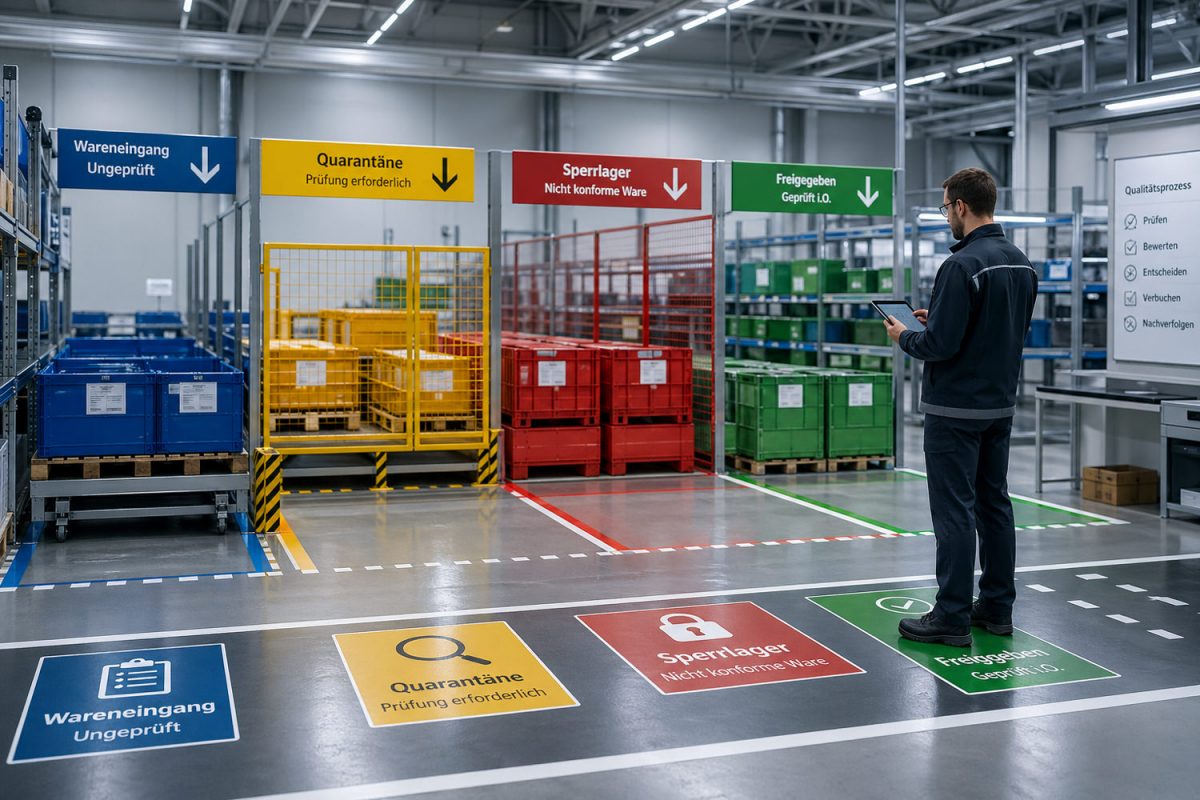
The images on this website were created using artificial intelligence (AI).
When something goes wrong in production, the defect itself is often not the most expensive part. It becomes truly costly when affected goods are not cleanly separated. Then OK and non-conforming parts get mixed, leading to re-sorting, delivery stops, unnecessary 100% inspections, and ultimately discussions that no one wins.
Blocked stock and quarantine exist precisely for this: so you maintain control. Not "put it somewhere," but organize it so that mixing factually cannot happen.
Blocked Stock vs. Quarantine: What Is the Difference?
In many companies, both are used interchangeably. In practice, the distinction is worthwhile:
-
Quarantine is the area for goods with unclear status. Suspicion, pending inspection, incomplete documents, uncertain batch.
-
Blocked stock is for goods that are actively blocked: clearly non-conforming or locked until release.
This distinction makes processes clearer: Quarantine = clarify. Blocked stock = block.
Goal: "Physically Impossible" Instead of "Please Be Careful"
You do not prevent mixing with appeals, but with a system. The best blocked stock area is designed so that errors can no longer be made "by accident."
The three most important principles:
-
Physical separation (not just a sign)
-
Clear labeling (status immediately recognizable)
-
Controlled access (not everyone can enter or rebook)
If any of these is missing, it is only a matter of time before goods end up back in circulation.
The Right Zoning: Simple but Strict
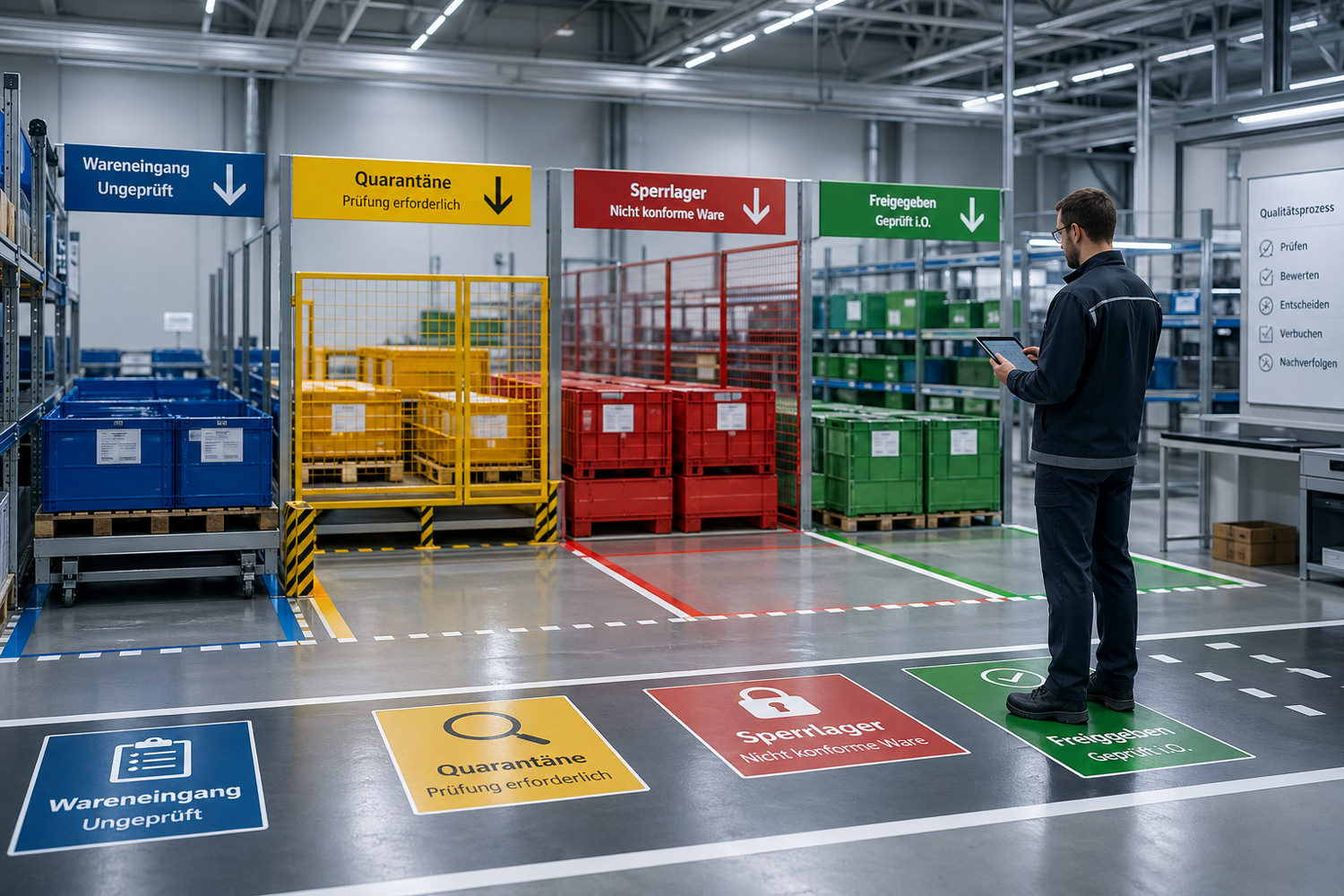
A functional layout requires clear areas with fixed rules. Four zones are typically sensible:
1) Incoming uninspected
Everything that arrives new or has not yet been evaluated.
2) Quarantine
Suspect goods, pending clarification, waiting area for test result/decision.
3) Blocked stock
Clearly blocked goods. No access without release process.
4) Released / OK
Goods that may re-enter the process—cleanly separated from everything else.
What matters is less the area than the consistency: no intermediate stacks, no "just put it here briefly," no mixed zones.
Labeling: Clear, Robust, Traceable
Labeling must function even in stressful situations. When someone sees a box during the night shift, it must be immediately clear: Can this go out or not?
Good labeling answers at a glance:
-
Status (uninspected / quarantine / blocked / released)
-
Reason (brief)
-
Date/time
-
Responsible person
-
Reference (batch, lot, period, order)
This can be a label, tag, or card system. What matters is that it is consistent and does not look different for every case.
Access Rules: Who May Do What and Who May Not?
Many instances of mixing do not happen maliciously, but because logistics or production "just needs material quickly." That is why you need clear access rules.
Pragmatically proven:
-
Quarantine and blocked stock are not freely accessible.
-
There are defined roles that may move goods.
-
Releases are clearly regulated: who decides, how it is documented, how it is relabeled.
If release happens "verbally," the risk is high that later no one knows why goods were back out.
Process: What Happens to Blocked Goods?
A blocked stock area is not a final repository. Every blocked item needs a next step; otherwise, inventory grows, overview declines, and eventually goods are rearranged "for space reasons," and that is exactly when mixing happens.
For every block, it should be clear what happens next:
-
Inspection / sorting
-
Rework
-
Return / supplier clarification
-
Scrap
-
Special release (rare but possible)
And: There must be a responsible person who actively "pulls" the case, instead of the goods being forgotten there.
Documentation: As Little as Possible, as Much as Necessary
You do not need to drown everything in paper, but you need a traceable trail:
-
when it was blocked
-
what is affected (scope)
-
where it is located
-
what the status is
-
what was decided
Without this, you lose time with every internal inquiry and with the customer.
Common Mistakes That Almost Guarantee Mixing
If you want to prevent mixing, eliminate these points:
-
Quarantine is "just an area in the warehouse" without clear demarcation
-
Labeling is inconsistent or too small / illegible
-
Blocked goods are restacked for space reasons
-
OK and non-conforming goods are in the same aisle
-
Releases happen verbally or via chat without clean proof
-
No inventory overview: no one knows how much is blocked and why
-
There are no fixed responsibilities, so goods remain sitting
These are the causes for a quality case becoming a logistics problem.
Conclusion: A Good Blocked Stock Area Saves Money, Nerves, and Time
Blocked stock and quarantine are not "nice to have." They are the foundation for you to steer cleanly in an emergency: contain errors, secure inventory, restore delivery capability, without goods slipping through uncontrolled.