



Visual Inspection vs. Measurement Testing: When Each Method Makes Sense
27. January 2026
Digital Reporting as a Game Changer in Professional Quality Assurance
10. February 2026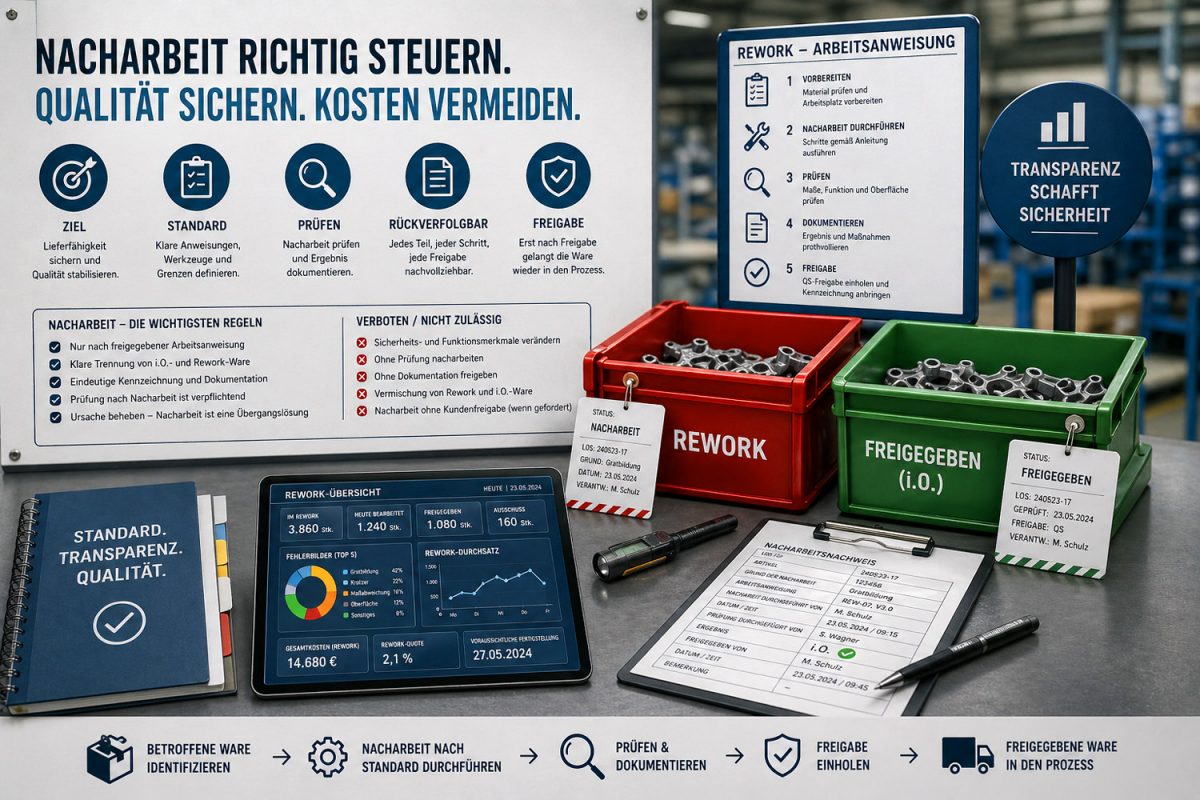
The images on this website were created using artificial intelligence (AI).
Rework can be a real lifeline—or the start of follow-up costs that come back to bite you months later. In many plants, rework happens under pressure: “Just get it out,” “we have to deliver.” That is exactly where the risks arise: mix-ups, unclear approvals, undocumented interventions, later complaints, and in the worst case functional failures at the customer.
If you manage rework correctly, you achieve two things at the same time: you ensure the ability to deliver and you stabilize quality—without buying yourself new problems.
The difference between good and bad rework
Good rework is controlled. Bad rework is improvised.
Controlled means: you know at all times
-
which material is affected,
-
what exactly was done to it,
-
which standard was followed,
-
who did it,
-
and how approval was granted.
Improvised means: the material is “worked on somehow,” but later no one can trace what exactly happened. Then every discussion with the customer, the plant, QA, or the complaints team is inevitable.
Standardize: rework needs clear boundaries
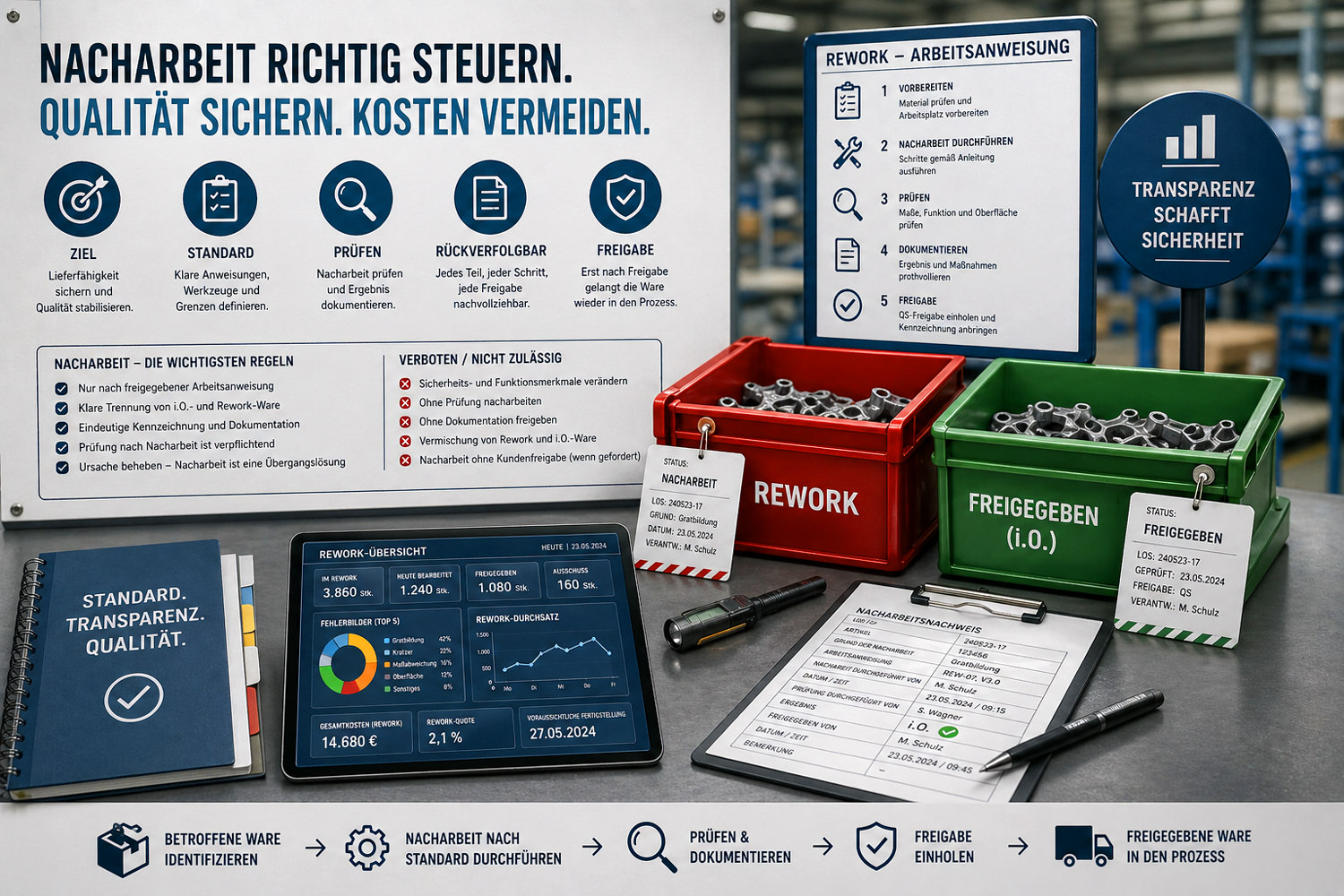
Rework must not depend on the gut feeling of individual employees. It needs a defined work instruction that works in practice. Not a 20-page document, but a clean standard that prevents errors.
Key components:
-
Objective of the rework: What is to be achieved? What must not be changed?
-
Steps and tools: Which tools, aids, parameters, and sequence?
-
Permissible rework limits: From what point is rework no longer permitted?
-
Inspection after rework: How is it confirmed that the part is OK again?
-
Safety and functional characteristics: What is off-limits, or only permitted with special approval?
If you do not define these points, rework becomes a lottery. And in series production, a lottery is always expensive.
Traceability: without it, you are vulnerable
Traceability is not just a “quality topic.” It is your safeguard. If questions arise later, you must be able to prove which parts were reworked and to which standard.
Three things are crucial here:
1) Clean separation
Rework material must not enter the same flow as OK goods. Physically separated, clearly labeled, clear routes.
2) Unambiguous identification
Every lot, every batch, or—depending on the risk—each individual part must be identifiable: status, date, reason, action, responsible person.
3) Documented proof of rework
Not “we did it,” but “we did it according to instruction X, version Y, inspected to criterion Z.”
This keeps things under control internally and keeps the customer calm externally.
Reduce scrap without diluting quality
The most common mistake: scrap is “pushed down” by doing too much rework. In the short term it looks good; in the long term complaints increase.
Good rework reduces scrap by:
-
intervening only where rework is technically sensible and approved,
-
inspecting properly and not waving borderline cases through,
-
not replacing root causes, but buying time to stabilize the process.
A robust approach is to view rework as a temporary measure: you ensure the ability to deliver while the root cause and process are addressed in parallel. If rework becomes the permanent state, something is fundamentally wrong.
Customer requirements and approvals: clear ground rules
Many customers accept rework only under certain conditions. And those conditions must be clear before you start. Otherwise, you do work that ultimately is not approved.
Typical customer points:
-
Scope of documentation (records, serial numbers, lot traceability)
-
Depth of inspection after rework (100% vs. sampling)
-
Identification of reworked goods
-
Approval process (who may approve, when goods are considered OK)
If you clarify this early, you avoid the classic situation: “Everything is done,” and then the follow-up question comes that stops everything.
Maintain the ability to deliver: rework needs cadence and control
Rework under pressure only works if it is managed like a process—not like a “catch-all.”
What matters is that you know at all times:
-
how much material is in rework,
-
how quickly it moves through,
-
how much of it becomes OK,
-
and where bottlenecks arise.
This is not a controlling game—it is production reality. Without this transparency, deadlines are pure hope.
Typical mistakes that cause follow-up costs
If you want to avoid follow-up costs, eliminate these classics radically:
-
Rework starts without an approved work instruction
-
OK goods and rework goods are not consistently separated
-
Criteria are unclear; inspection results vary
-
Rework is not identified; later nothing is “traceable” anymore
-
There is no defined inspection after rework
-
Borderline cases are waved through due to time pressure
-
The customer is involved too late; approval comes only after the work
-
Rework becomes a permanent state instead of a temporary measure
These are exactly the points that seem “quick” at first and become expensive later.
Conclusion: rework is only a gain if it is controlled
Rework can save quality and ensure the ability to deliver. But only if it is standardized, traceable, and properly approved. Anything else is a risk you will pay for later—with complaints, additional sorting, or in the worst case, loss of the customer.
If you need to set up rework at short notice or want to make your rework process more stable, we support you pragmatically: clear standards, clean separation, robust documentation, and reporting that holds up internally and externally.