



Visual Inspection vs. Measurement Testing: When Each Method Makes Sense
27. January 2026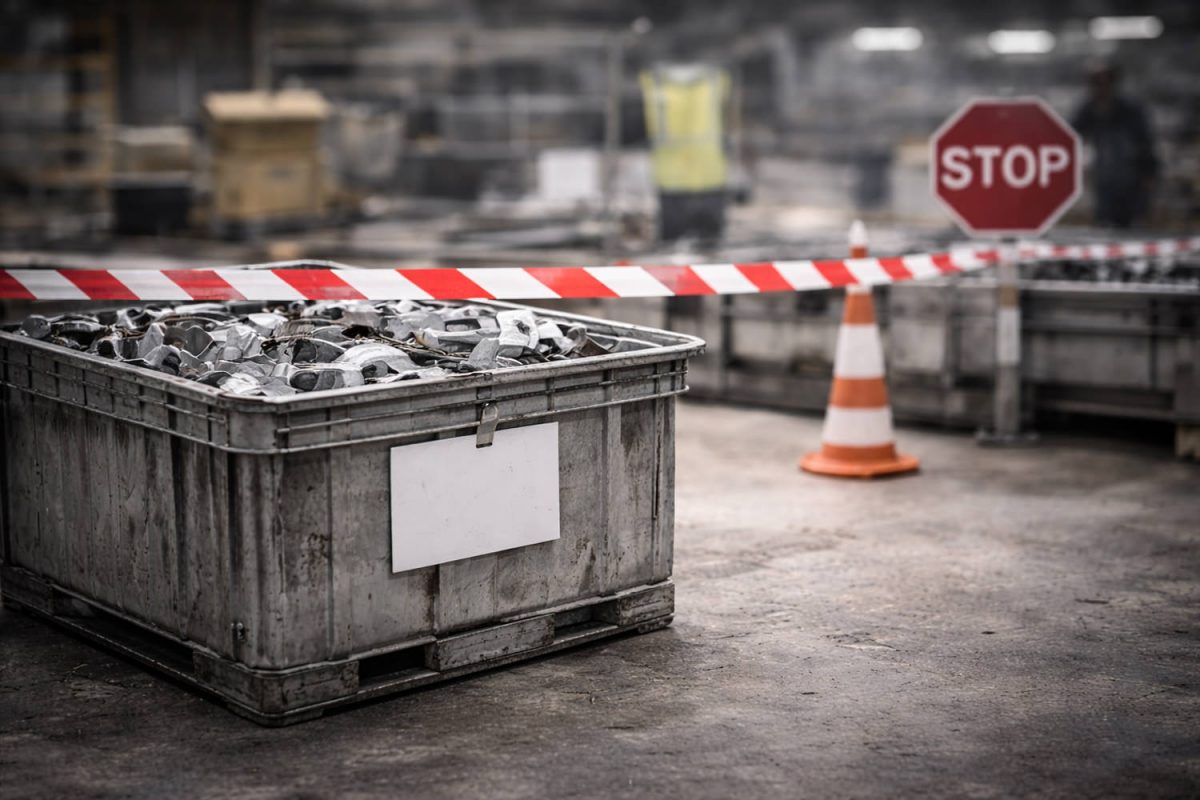
The images on this website were created using artificial intelligence (AI).
Quality deviations in production are not the exception—they are reality. What matters is how quickly and how cleanly you respond. If you just do “something” now, you will pay twice later: through mixing, unnecessary sorting costs, delivery delays, complaints, or missing evidence.
This article focuses on what truly works in practice: setting up blocking, sorting actions, and rework in a way that restores control over inventory, process, and ability to deliver.
The first 30 minutes: control instead of discussion
As soon as a deviation is detected, only one thing matters: containment—i.e., reliably isolating the problem before it spreads further.
This involves three quick decisions:
-
Stop or control material flow: What may continue, and what may not?
-
Secure inventory: Where is affected material located (line, buffer, warehouse, shipping, at the customer)?
-
Clarify criteria: What is “OK” and what is “NOK”? Without clear criteria, any sorting is worthless.
If, at this stage, you “quickly finish production” or “wait and see,” a defect pattern often turns into a logistics and cost problem.
Do blocking properly: physical, systemic, traceable
Blocking is more than a note on a stack of mesh boxes. It must be set up so that no one accidentally pulls material back into the process.
What matters:
-
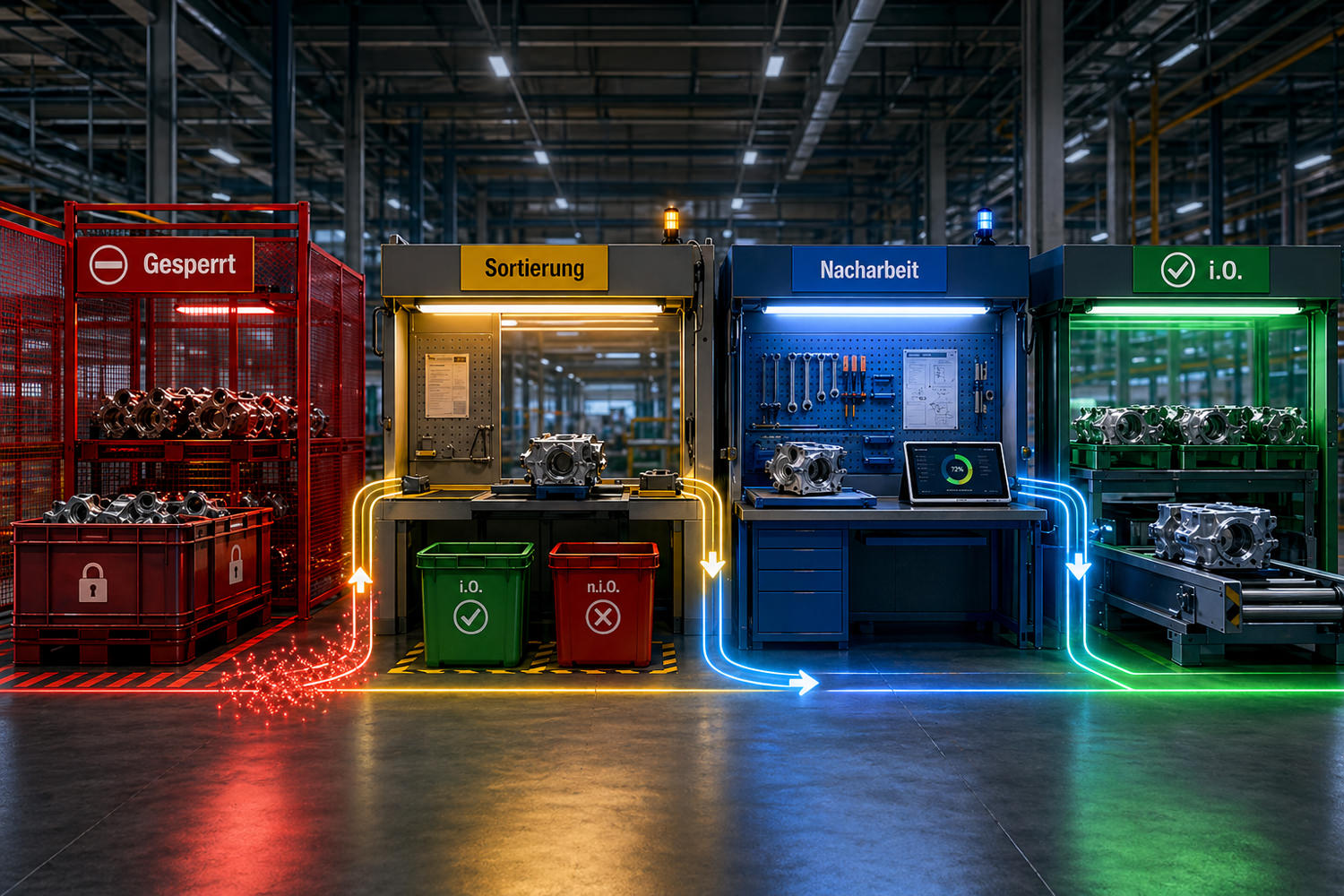
Physical quarantine: a defined blocked area, clearly separated, access only for authorized personnel.
-
System block: ERP/MES/scanner logic set up so that no posting or picking is possible.
-
Clear identification: status, date/time, reason, responsible person, affected batches/time periods.
-
Define the scope: which part numbers, delivery lots, production periods, lines, tools, and shifts are affected.
-
Ensure traceability: so you do not have to block “everything” because you do not know what is truly affected.
Rule of thumb: it is better to block a bit too broadly for a short time and quickly narrow it down properly than to block too narrowly and then have to block again later because material slipped through.
Roles: who decides, who executes, who documents
Many measures fail not because of technology, but because of responsibilities. If, in the end, “everyone is somehow” responsible, then no one is responsible.
In practice, you need at least these clearly defined roles:
-
Decision-maker (Quality/Production Management): makes stop/go decisions, sets priorities, escalates to the customer.
-
Containment owner: keeps scope, inventory, block status, and actions aligned.
-
Sorting/Rework lead: leads the team, trains on criteria, manages pace and flow.
-
Documentation owner: ensures evidence is complete, version-controlled, and auditable.
-
Logistics: blocks, moves, separates, prevents mixing.
-
Customer/Incoming goods (if affected): alignment on criteria, releases, special rules.
This does not have to be bureaucratic. But it must be unambiguous.
Sorting action: only useful if criteria and process are right
Sorting is not an end in itself. The goal is not “a lot checked,” but “released with confidence.”
A properly set up sorting action depends on:
-
Inspection criteria on one sheet: unambiguous, with images, limit samples if possible, no room for interpretation.
-
Inspection environment and tools: lighting, gauges, measuring equipment, cleanliness, handling.
-
Training before the start: a 10-minute briefing saves hours of complaints later.
-
Separation of OK / NOK: separate containers, clear routes, no mixed areas.
-
Second check for critical characteristics: sampling check or four-eyes principle, depending on risk.
-
Ongoing transparency: quantities, defect types, scrap rate, progress, status of blocked inventory.
If, in the end, you cannot clearly say, “This quantity was inspected to criterion X, version Y, by team Z,” then the result is open to challenge.
Rework: only with an approved work instruction
Rework can safeguard your ability to deliver, but it can also cause downstream damage if it is done “by feel.” Therefore: no rework without defined limits.
Important:
-
Work instruction (Rework Instruction): steps, tools, permissible rework limits, safety and quality characteristics.
-
Inspection after rework: What is verified, and how? Visual inspection is often not sufficient.
-
Identification of reworked material: traceability, so there is no discussion later.
-
Keep risk in mind: for safety-relevant parts or functional characteristics, rework is not always permissible.
Rework is good when it is controlled. Uncontrolled rework is often just hidden scrap.
Documentation: the minimum you always need
You do not have to “produce paperwork,” but you must be able to prove what happened. This saves discussions, protects you internally and externally, and speeds up releases.
At a minimum, the following make sense:
-
Blocking log (scope, time, responsible persons)
-
Inspection criteria/inspection instruction (version, date)
-
Sorting log (quantities, defect types, result)
-
Rework instruction + rework record
-
Release decision (who, when, for what)
-
Traceability overview (batches/lots/time periods)
Typical mistakes that cost time and money
These are the classics we see again and again in practice:
-
Blocking only “visually,” but still bookable in the system
-
Scope is not clearly defined, resulting in too much or too little being blocked
-
Inspection criteria are unclear or change without version control
-
Sorting team starts without training and without limit samples
-
OK and NOK are too close together physically, and mixing occurs
-
No clean traceability, so “everything” is sorted as a blanket measure
-
Rework without defined limits, leading to functional issues later
-
Status communication is missing: no one knows how far along the action is
-
Documentation is “rebuilt” at the end instead of being maintained live
If you avoid these points, you gain not only quality, but above all speed.
How to get breathing room quickly: a pragmatic workflow
A proven workflow looks like this:
-
Containment & blocking (immediately)
-
Narrow down the scope (data, time window, batches, line)
-
Define the sorting and rework concept (criteria, pace, resources)
-
Execute with live reporting (daily or by shift)
-
Release & stabilization (safeguard the process, address the root cause)
Root cause analysis (e.g., 5 Why, Ishikawa, 8D) is important, but it must not delay containment. Control first, then solve sustainably.
If you need support
If you need to set up a sorting action or rework quickly and properly, a structured start is essential: clear roles, clear criteria, clean separation, and documentation that convinces the customer.
That is exactly what we support you with: at short notice, pragmatically, and with a focus on ability to deliver and robust, auditable evidence.
If you wish, please send us the part, quantity, defect pattern (preferably with a photo), deadline, and current warehouse/shipping status with your enquiry. That way, we can get specific faster.